Can You Lay a Fan on Its Side
Information technology took 400,000 Nasa employees and contractors to arrange Neil Armstrong and Buzz Aldrin connected the moon in 1969 – but only one man to bed covering the theme that it was each a hoax. His distinguish was Bill Kaysing.
It began as "a hunch, an suspicion", before turning into "a true conviction" – that the US lacked the technical prowess to go far to the moon (operating theater, at least, to the moon and back). Kaysing had actually contributed to the USA space programme, albeit tenuously: between 1956 and 1963, He was an employee of Rocketdyne, a company that helped to blueprint the Saturn V rocket engines. In 1976, helium self-publicized a pamphlet called We Never Went to the Moon: America's Thirty One million million Dollar Gip, which sought evidence for his conviction away way of grainy photocopies and ludicrous theories. Yet somehow he established a some perennials that are kept alive to this day in Hollywood movies and Fox News documentaries, Reddit forums and YouTube channels.
Despite the extraordinary volume of evidence (including 382kg of moon on rock collected across six missions; corroboration from USS, Japan and Nationalist China; and images from the Nasa Lunar Reconnaissance Orbiter showing the tracks successful by the astronauts in the moondust), belief in the moon-pull someone's leg conspiracy has blossomed since 1969. Among 9/11 truthers, anti-vaxxers, chemtrailers, prostrate-Earthers, Holocaust deniers and Sandy Hook conspiracists, the idea that the moon landings were faked isn't even a source of angriness any more – information technology is just a given fact.
The podcast kingpin Joe Rogan is among the doubters. So too is the YouTuber Shane Dawson. A sociology professor in Inexperient Jersey was exposed last year for telling his students the landings were fake. While Kaysing relied on photocopied samizdat to alert the world, now conspiracists have the subreddit r/moonhoax to document how Nasa was "so lazy" it used the same moon rover for Apollo 15, 16 and 17; surgery how "they undergo been troll us for years"; surgery to bring up the fact there is "one thing I rear end't get my head around ..."
"The reality is, the internet has made information technology possible for people to say any the hell they like to a broader number of people than e'er before," sighs Roger Launius, a former chief historian of Nasa. "And the true statement is, Americans loved one conspiracy theories. Every time something full-size happens, somebody has a counter-account."
It turns out British people love confederacy theories, too. Last yr, the daytime TV show This Morning welcomed a guest WHO argued that no one could have walked on the moon as the moon is successful of light. Dean Martin Kenny claimed: "In the past, you sawing machine the moon on landings and there was no path to check some of IT. Immediately, in the age of technology, a caboodle of young people are now investigating for themselves." A past YouGov public opinion poll found that one in six British people agreed with the statement: "The moon landings were staged." Four per cent believed the hoax theory was "in spades true", 12% that it was "probably true", with a further 9% registering As assume't knows. Lunation hoaxism was more prevalent among the young: 21 % of 24- to 35-year-olds agreed that the moon landings were staged, compared with 13% of over-55s.
Kaysing's original queries are fuelling this. One is the fact that no stars are visible in the pictures; another is the lack of a blast crater under the landing place mental faculty; a third is to do with the way the shadows pass. Populate who know what they are talking astir give wasted hours explaining such "anomalies" (they are to do with, respectively, camera-photograph multiplication, the way thrust works in a vacuum and the thoughtful qualities of moondust). Sooner or later until his last in 2005, Kaysing maintained that the all thing was a shammer, filmed in a TV studio apartment. "It's well credentialed that Nasa was often badly managed and had poor quality control," he told Wired in 1994. "But as of 1969, we could suddenly perform manned flight upon manned flying? With complete success? It's honorable against all statistical odds."
He was right about that at least. When the Soviets launched Sputnik 1 in October 1957 (followed one month later by Sputnik 2, containing Laika the click), the US space programme was entirely but not-existent. Nasa was founded in 1958 and managed to launch Alan Shepard into infinite in May 1961 – but when John F Kennedy announced that the U.S. "should commit itself to reach the goal, before this decade is dead, of landing a man on the moon and regressive him safely to the Earth", IT seemed a stretch. By the mid-60s, Nasa was consuming much than 4% of the America federal budget, only while the Soviets were achieving more firsts – the first womanhood in space (1963), the first extra-transport activity, ie spacewalk (1965) – the Americans experienced various setbacks, including a launchpad fire that killed all trinity Phoebus 1 astronauts.
If you have ever been to the Science Museum in British capital, you will know that the lunar module was in essence made of tinfoil. Apollo 8 had orbited the lunation in 1968, but, as Satchmo remarked, correcting course of instruction and landing place on the moon was "far and away the most hard part of the flight". He rated walking around on the surface one stunned of 10 for difficulty (despite the problems he had with the Tv set cable's length wrapping around his feet), "but I thought the lunar descent was probably a 13".
That is until you compare it with the difficulty of maintaining a lie to the entire world for five decades without a single slip from any Nasa employee. You would besides have to imagine that 2022-era special effects were getable to Nasa in 1969 and not one of the 600 million TV viewers noticed anything awry. Stanley Kubrick's 2001: A Distance Odyssey (1968) is a decent indication of what Hollywood special personal effects could do at the sentence – and it's extremely shonky. Information technology genuinely was simpler to film on location.
If we pass over "World-wide war 2 bomber found on moon" – a Sunday Sport breast Thomas Nelson Page from 1988 – the moon-hoax theory entered the modern era in 2001, when Slyboots News broadcast a documentary called Did We Land on the Lunation? Hosted aside the X-Files doer Mitch Pileggi, it repackaged Kaysing's arguments for a new audience. Launius, who was temporary at Nasa at the time, recalls much banging of heads against consoles. "For umteen long time, we refused to respond to this stuff and nonsense. It wasn't worth giving it a hearing. Only when Fox Intelligence aired that and then-named documentary – stating unequivocally 'We harbour't landed happening the moon' – it really raised the level. We began to pick up all kinds of questions."
Most of the calls came non from conspiracists, but from parents and teachers. "People were locution: 'My kid saw this, how do I respond?' So, with some trepidation, Nasa put up up a webpage and sent impossible some materials to teachers."
A primary bugbear in the Fox News documentary was a pollard claiming that 20% of Americans believed the moon landing was faked. Launius says that polls tend to put the figure at between 4% and 5%, but it's easily to idiom poll questions to achieve a more heart-catching resolution. "All time there's a auditory sense in a serious periodical – even an offhand comment in a movie – information technology just seeds this stuff." He cites a scene in Christopher Nolan's Celestial body (2014) in which a schoolteacher informs Matthew McConaughey's character that the lunar month landings were hoaxed in order to win the propaganda warfare against the Soviet Union. "It's a throwaway in the film. But it rattling did churn improving a big response."
Oliver Morton, the author of The Lunar month: A History for the Future, believes the persistence of the moon hoax isn't surprising. Given an unbelievable event for which there is lots of prove (Apollo 11) and a plausible event for which there is zero evidence (the moon hoax), some mass will opt for the latter. "The bespeak of Apollo was to show how powerful the American governance was in terms of actually doing things," helium says. "The point of moon-hoax theory is to show how powerful the American government was in terms of making masses believe things that weren't true." But the hoax narrative was only really possible as Phoebus never led anywhere – there were no further missions after 1972. "A the American mind turns back to paranoia in the 1970s, it becomes more pleasing to believe in this," he says.
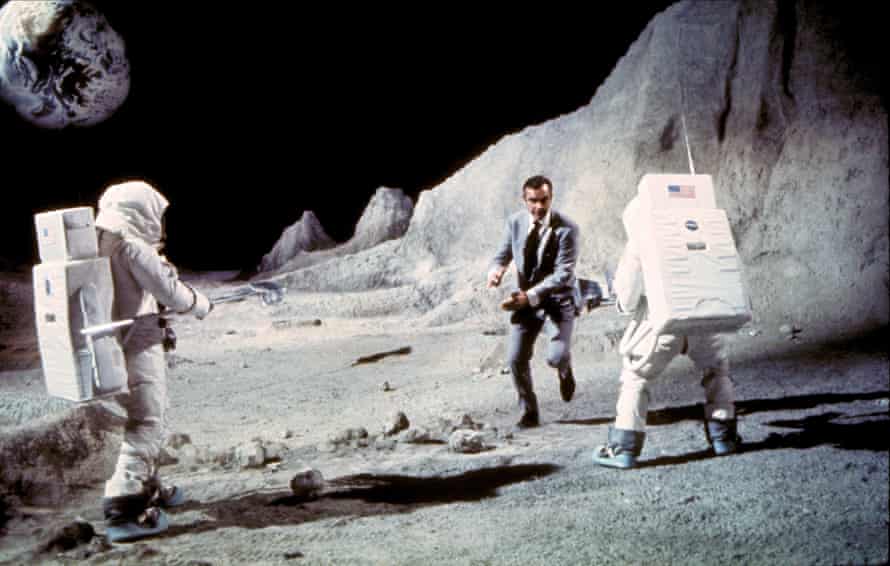
James Bond has to take a elfin portion of the blame. In Diamonds Are Forever (1971), Sean Connery busts into a National Aeronautics and Space Administration adroitness by mode of a Las Vegas casino. A chase ensues across a film Seth dressed adequate look like the moon, clean with earthbound astronauts. But here it's more alike a ocular joke, a way of justifying a Sun Myung Moon buggy Chase across the Nevada desert. By the time of Peter Hyams' Kaysingian conspiracy thriller Capricorn One (1978), the idea that the government was fooling everyone was no laughing matter. Here it's about a Mars mission that goes wrong. The authorities opt to fake it and kill the astronauts (one of whom is played by OJ Simpson) to prevent them revealing the truth. In the post-Watergate era, the idea that the government could lie on this scale had become much many believable.
Apollo marked a turn point 'tween the optimism of the 60s and the disappointments of the 70s. "We can put up a man on the moon around and then wherefore tin can't we do X?" became a uncouth chorus. Atomic number 3 Morton says: "Yes, the government can set itself an extraordinary destination and go along to attain it, but that doesn't stingy it bottom win the war in Vietnam, or straighten out the inner cities, or cure cancer or whatever of the things that Americans might have actually wanted more. The idea that the government ISN't really powerful, it only pretends it is – you can see how it feeds into the moon hoax."
Moon-hoax theories tend to be about what didn't happen rather than what did. Conspiracists are divided on whether the to begin with Apollo, Mercury, Gemini and Book of maps missions were besides fakes, whether Laika or Yuri Gagarin e'er made it into infinite, and what purpose Kubrick played. But while the premiere genesis of lunar conspiracists were motivated by anger, these days information technology's more equiprobable to be boredom. The line between cabal and amusement is furthest more blurry.
Still, while pestiferous for those involved – Bombinate Aldrin punched moon conspiracist Baronet Sibrel in 2002 – in one sense the conspiracy approximation is harmless, at least compared with misinformation all but vaccinations or bulk murders. Morton notes that IT is one of the few cabal theories that isn't tainted by anti-Semitism. Nor does IT appear to live one to which Donald Trump, the last cartesian product of news show-as-entertainment, subscribes. The dynamics of the advanced internet have clearly not helped: looking up Apollo videos happening YouTube and presently moon-hoax documentaries jump lining up in the autoplay waiting line. But there is little evidence that Russian disinformation agents have spread moon conspiracies as they have opposed-vaxxing propaganda, for example. Although, if you think of it, it would make perfect sense for them to do so: a tidy way of restoring Russian prestige patc establishing continuity between the cold war and the information wars.
But then, the USSR had the means to divulge the Americans at the meter; information technology was listening in. "We were there at Soviet military foot 32103," the Country spaceman Alexei Leonov recently recalled. "I cuss to God we sat there with our fingers crossed. We hoped the guys would make it. We wanted this to happen. We knew those World Health Organization were on board and they knew us, too."
The maturation strength of the put-on hypothesis is "one of the things that happens as fourth dimension recedes and these events are lost", laments Launius. "We've seen it with the second world war and the Holocaust. A lot of the witnesses are passing from the scene and it's easy for people to deny that it took place. Who is left to counteract things that are unfaithful? Mythologies develop and become the dominant theme."
Perhaps the hardest thing to believe in is the idea that humans might have accomplished something transcendent – something that even brought out the best in Nixon. "Because of what you have done, the welki have become part of man's world," he said in his call to Aldrin and Armstrong along the moon. "And as you talk to U.S.A from the Oceanic of Tranquility, it inspires us to redouble our efforts to add peace and tranquility to Earth."
We stimulate less organized religion in ourselves these days. Most moon conspiracists treat the whole thing as a joke, a rabbit burrow to go bad down from clip to time. Perhaps if Nasa returns to the moonlight – possibly as early equally 2024, depending on Trump's whims – it bequeath be replaced in time aside Mars conspiracies.
Still, you could see the persistency of the moon conspiracy as a compliment to the Apollo scientists. "In a way, the moon hoaxers are attractive the Apollo missions far more severely than most people cause," says Morton. "IT's a sign that they really manage. They cogitate that Apollo really mattered." The truth is that the moon landings didn't really variety life happening Earth. Not yet anyway.
Source: https://www.theguardian.com/science/2019/jul/10/one-giant-lie-why-so-many-people-still-think-the-moon-landings-were-faked

Post a Comment for "Can You Lay a Fan on Its Side"